
Wood chips need to be dimensionally stable before fuel or pelletizing, but the same mesh opening does not automatically produce the same results. Wet softwoods, dry hardwoods and boards break in different ways, and tool wear and recycled material can also change the particle size distribution.
Material characteristics
- Pallets, furniture boards, construction lumber and garden branches vary widely in size, wood species, moisture content and metal attachments.
- Nails, corners, sand, plastics and coatings can affect wear, magnetic separation and the use of the finished product.
- Pelletizing, fuel, board raw materials and volume reduction external sales correspond to different wood chip particle size, fine powder and moisture content requirements.
Key processing challenges
- Wood with a high water content is less likely to break and the screen holes may become clogged.
- After the tool becomes dull, the long material increases, and the fine powder and energy consumption may also change.
- Too much recycled material will occupy the host capacity and increase fine powder.
Equipment-selection criteria
- Determine the feed inlet, conveying and anti-bridging design based on the largest wooden parts, stacking method and forklift or gripper loading.
- Check the allowable boundaries of cutters, low-speed drives and metal parts containing nailed wood, and set appropriate magnetic separation positions.
- Secondary crushing, screening, iron removal, dust removal and storage solutions are deduced from the end use.
Typical process flow
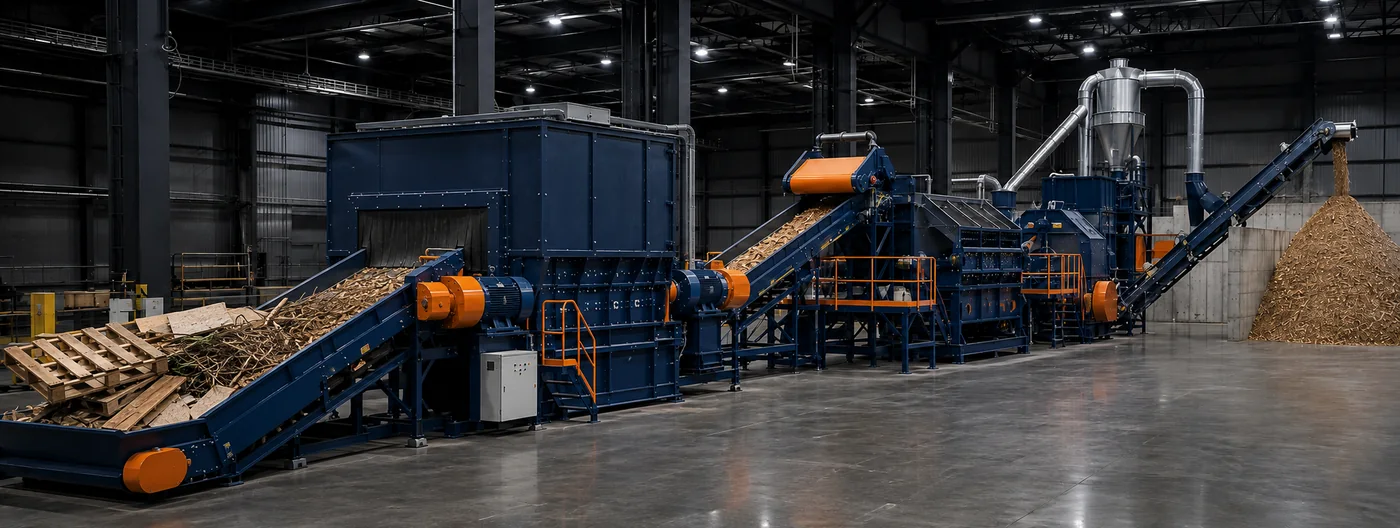
The primary shredding is responsible for volume reduction and iron removal, and the secondary equipment cooperates with the screen to control wood chips. Through regular sampling, statistics of oversized materials, qualified materials and fine powders are carried out, and the proportion of tool maintenance and returned materials is adjusted.
Information required before project evaluation
Complete information helps us define equipment limits, test plans and the full line accurately:
- Waste wood types, sources and proportions of each type
- Maximum size, thickness, moisture content and stacking method
- Nails, sand, plastic and coating conditions
- Target chip sizes, fines and end uses
- Hourly throughput, shifts and loading methods
- Magnetic separation, dust removal, fire protection and storage conditions