
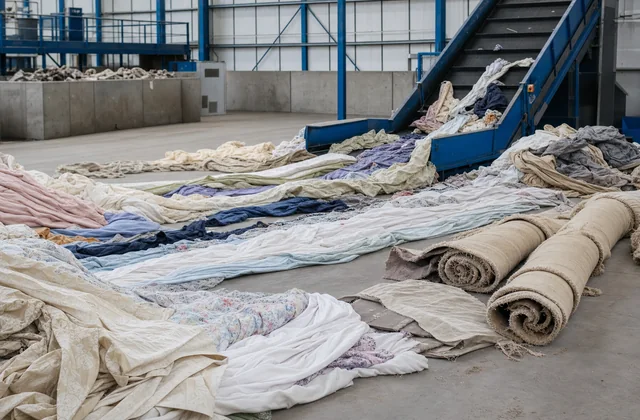
Clothes, curtains, carpets and bedding are not outstanding in hardness, but may form continuous entanglements due to their length and flexibility. Buttons, zippers, footwear and wet debris will change the actual incoming materials, and the equipment needs to be evaluated according to the most complex combinations.
Material characteristics
- The volume, density and material of bulky waste and mixed domestic waste change rapidly, and wood, fabric, sponge, plastic and metal may appear in the same batch.
- Springs, long fabrics, ropes and films have a tendency to become entangled, and glass, stones, batteries and sealed containers need to be identified in advance.
- The value of the project depends on subsequent sorting and receiving channels. Simply reducing capacity cannot automatically form usable products.
Key processing challenges
- Long cloth strips will continue to accumulate after being wound around the shaft, eventually affecting the shaft end and discharging.
- The bulk density of loose textiles is low, and the manual feeding rhythm is unstable.
- Metal accessories and water-containing dirt affect cutting tools, conveying and finished product utilization.
Equipment-selection criteria
- Determine the boundaries of unloading, grabbing, conveying and shredding equipment according to the maximum incoming material, collection and transportation mode and peak beat.
- Focus on checking anti-winding, automatic reversal, foreign object protection, cleaning convenience and shaft end sealing.
- Configure magnetic separation, screening, air separation or manual sorting according to target components such as metals, wood materials, light materials, etc.
Typical process flow
The textiles are first sorted to remove obvious metal, footwear and wet dirt, and then compressed or quantitatively loaded into shreds. Subsequently, iron removal, screening and baling are configured according to the direction of fuel, recycled fiber or filler.
Information required before project evaluation
Complete information helps us define equipment limits, test plans and the full line accurately:
- Incoming materials list, sources and seasonal proportions
- Maximum size, unit weight and packing density
- Spring, Fabric, Glass and Hazardous Foreign Object Conditions
- Collection, unloading and loading methods
- Target components, particle size and downstream fate
- Site, labor, noise dust and fire protection conditions