
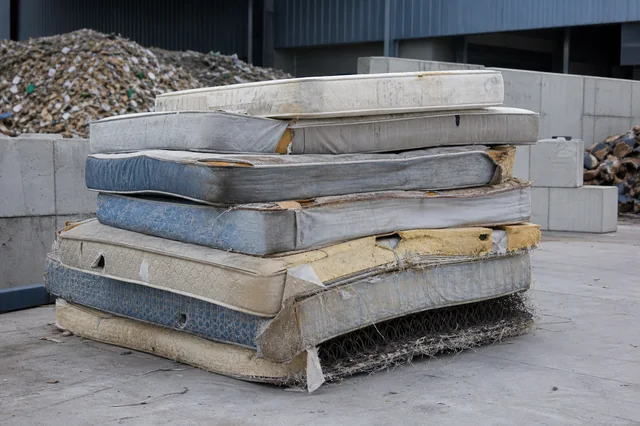
Mattress is not a homogeneous soft material. Internal springs, frame wires, fabrics and sponges all respond differently when broken. Reliance solely on high power does not eliminate entanglement; the degree of pre-disassembly and equipment cleanability are often more critical.
Material characteristics
- The volume, density and material of bulky waste and mixed domestic waste change rapidly, and wood, fabric, sponge, plastic and metal may appear in the same batch.
- Springs, long fabrics, ropes and films have a tendency to become entangled, and glass, stones, batteries and sealed containers need to be identified in advance.
- The value of the project depends on subsequent sorting and receiving channels. Simply reducing capacity cannot automatically form usable products.
Key processing challenges
- The long spring may stretch across the cutter axis and become entangled.
- Fabrics and sponges are large in size and low in density, making stable feeding difficult.
- If there is insufficient space during shutdown and cleaning, shift output will be significantly reduced.
Equipment-selection criteria
- Determine the boundaries of unloading, grabbing, conveying and shredding equipment according to the maximum incoming material, collection and transportation mode and peak beat.
- Focus on checking anti-winding, automatic reversal, foreign object protection, cleaning convenience and shaft end sealing.
- Configure magnetic separation, screening, air separation or manual sorting according to target components such as metals, wood materials, light materials, etc.
Typical process flow
Incoming materials are first inspected for dangerous foreign objects, and whether to remove large pieces of metal can be decided based on local labor costs. Afterwards, the machine is used for loading, low-speed shredding, magnetic separation and manual quality inspection. Wooden or light materials are then diverted according to their destination.
Information required before project evaluation
Complete information helps us define equipment limits, test plans and the full line accurately:
- Incoming materials list, sources and seasonal proportions
- Maximum size, unit weight and packing density
- Spring, Fabric, Glass and Hazardous Foreign Object Conditions
- Collection, unloading and loading methods
- Target components, particle size and downstream fate
- Site, labor, noise dust and fire protection conditions