
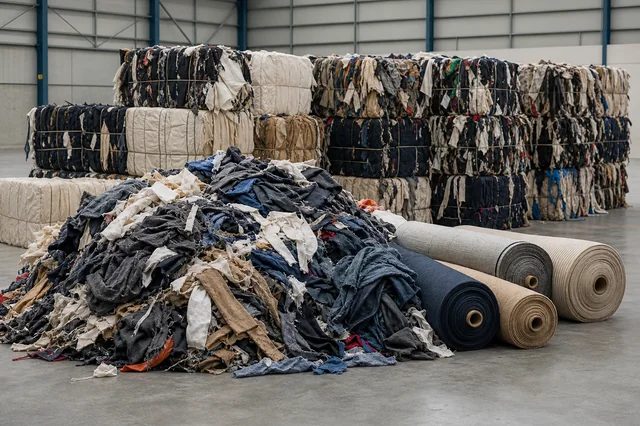
Production scraps are cleaner than household waste textiles, but continuous strips, rolls and high-strength fibers will create stable tension. When feeding into bales, materials may cross multiple sets of knives at the same time, causing entanglement and load fluctuations.
Material characteristics
- Industrial solid waste changes with production processes and may be mixed with plastics, rubber, fibers, thin metals, fiberglass and adhesives.
- Rolls, strips and sheets are prone to snagging, and thick blocks and metal inserts can create concentrated loads and wear.
- If the discharge material needs to be returned to production or entered into sorting, particle size distribution and contamination control are usually more important than simple volume reduction.
Key processing challenges
- The long and rolled materials form a rope bundle effect after entering the knife box.
- Aramid, polyester and rubberized fabrics have different cutting responses.
- Fasteners, needles and packaging ties may be mixed in with the scraps.
Equipment-selection criteria
- Use a bill of materials and representative samples to define normal batches, extreme batches, and foreign matter that must be removed.
- Select a single-shaft, dual-shaft or secondary crushing combination according to the form and objectives, and check the cutter, screen and drive configuration.
- Incorporate cleaning, tool changing, foreign object removal, and wearing parts replacement times into actual availability assessments.
Typical process flow
The edge materials are classified according to fiber and glue content, and the roll materials can be cut off or expanded quantitatively. After shredding, the accessories are removed through magnetic separation and screening, and then packaged according to the requirements of recycled fiber, filler or alternative fuel.
Information required before project evaluation
Complete information helps us define equipment limits, test plans and the full line accurately:
- Materials, production sources and proportions of various types
- Maximum size, thickness, form and packing density
- Metal, fiberglass, sand and adhesive conditions
- Normal and peak processing volumes, batch patterns
- Target particle size, fines limits and finished product uses
- Samples, field interfaces and safety information