
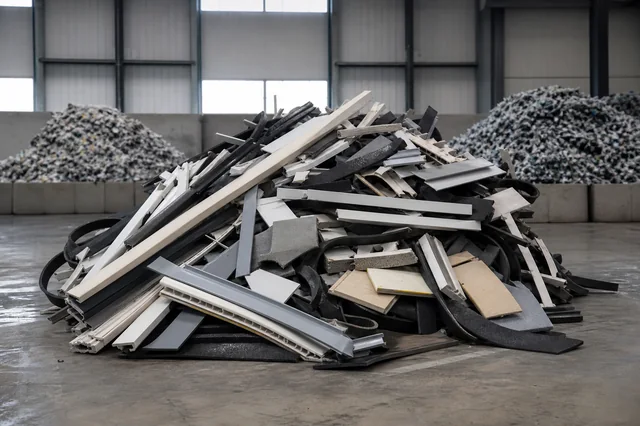
Industrial scraps may come from injection molding, packaging, automotive interiors, composites or assembly processes. Even with the same name, the recipes, reinforcements, and inclusions can be completely different from factory to factory. Therefore, the selection should be based on the bill of materials, representative samples and clear discharge purposes.
Material characteristics
- It may contain plastics, rubber, fibers, thin metals and adhesives, with both hard and soft components coexisting.
- Scraps in rolls, strips and sheets are prone to winding; thick blocks and sprue materials can cause concentrated loads.
- The batches change with the production plan, and the bulk density, moisture content and impurity content are not necessarily stable.
Key processing challenges
- Estimating the load based only on the material name may easily ignore the wear and tear caused by fiberglass, steel wire or metal inserts.
- When soft long materials and hard thick materials are collinear, the requirements for biting, discharging and reversal control are different.
- If the discharge material needs to be sorted or returned to the production process, particle size distribution and contamination control are often more important than simple volume reduction.
Equipment-selection criteria
- First conduct sample testing on representative normal batches and extreme batches, and record the current, discharging and winding conditions.
- Choose a single-shaft or double-shaft shredding method according to the material form and finished product requirements, and check the cutter, screen and drive configuration.
- Incorporate wearing parts replacement, foreign object removal and cleaning time into production line availability assessment.
Typical process flow
The process can start from source classification and manual inspection, and then proceed to magnetic separation or other sorting after quantitative feeding and primary shredding. When a more uniform particle size is required, a secondary crushing with a screen is installed; for materials with high dust or volatile content, closed transportation, dust collection and safety measures should be evaluated simultaneously.
Information required before project evaluation
Complete information helps us define equipment limits, test plans and the full line accurately:
- Various materials, formulas or sources and proportions
- Maximum size, thickness, form and packing density
- Proportion of metal, fiberglass, sediment and other inclusions
- Normal and peak processing volumes and batch changes
- Target particle size, allowable fines ratio and finished product use
- Representative samples, site process limitations and safety information