
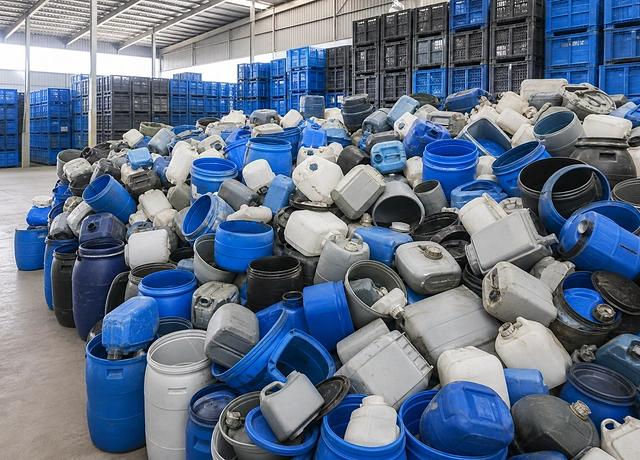
Plastic barrels, logistics boxes and turnover baskets are usually hollow or box-type hard plastics. They appear to be made of a single material, but differences in size, stiffeners, metal accessories and residues will directly affect the continuity of feeding and subsequent cleaning load. The boundaries of the raw materials should be defined at the beginning of the project, and then the equipment specifications should be discussed.
Material characteristics
- The hollow structure results in low stacking density and large volume occupation, making it easy to build bridges manually or when conveying and loading materials.
- Common materials such as HDPE and PP have different toughness and wall thickness, and the box reinforcements will form partially thick materials.
- Lids, handles, labels and metal pins may be mixed in; different packaging purposes require different residue disposal requirements.
Key processing challenges
- The large-size box needs to match the feed port and pressing method to avoid repeated bouncing or bridging.
- Thin-walled parts are easy to slip, and thick-walled parts will form instantaneous loads. The tool's material biting ability and low-speed torque need to be evaluated at the same time.
- Containers with oil stains, chemicals or a large amount of sediment cannot only be configured as clean plastic. Safe disposal and cleaning boundaries need to be determined first.
Equipment-selection criteria
- Determine the feed port, hopper and conveying system based on the maximum overall size, single piece weight and feeding method.
- Select the knife thickness, knife shape and screening method according to the target discharging and subsequent crusher feeding requirements, and do not blindly pursue the production of fine materials at one time.
- Combined with continuous operating time, material fluctuation and foreign body risk assessment drive, overload protection and serviceability.
Typical process flow
The typical process can start with manual inspection or pre-sorting, and then enter the magnetic separation after conveying and loading, low-speed shredding; when regeneration and granulation is required, fine crushing, friction cleaning, rinsing, dewatering and homogenization are continued. If the project only involves volume reduction or external sales of coarse materials, the process can be shorter, but the discharge specifications should still be consistent with the downstream receiving conditions.
Information required before project evaluation
Complete information helps us define equipment limits, test plans and the full line accurately:
- Plastic types and respective proportions
- Maximum and common unit dimensions, wall thicknesses and weights
- Residue type, moisture content, sediment and metal accessories
- Hourly and daily planned throughput, work shifts
- Target discharge size and subsequent cleaning, sorting or granulation requirements
- On-site power, space, loading methods and environmental protection conditions