
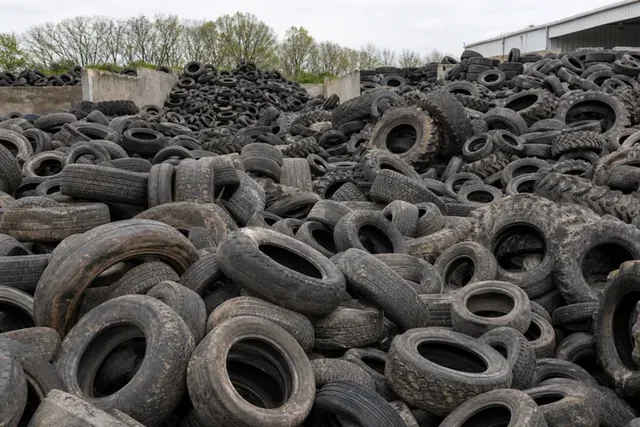
Waste tires are not raw materials with uniform specifications. Car tires, truck and bus tires, agricultural tires and engineering tires differ greatly in outer diameter, tire width, steel wire structure and rubber thickness. If hybrid tires are designed only according to average size, it is usually difficult to ensure safe feeding, stable material bite and subsequent wire separation at the same time.
Material characteristics
- The rubber has elastic and high friction properties, and the beads and cords contain steel wires.
- Tires of different models come in a wide range of sizes, and some engineering tires may also have mud, stones or inner linings.
- The bulk density of the whole tire is low, and the volume is significantly reduced after shredding, but the discharge shape depends on the downstream use.
Key processing challenges
- Bead wires increase shear loads and may wrap or accelerate localized wear.
- Large-diameter tires and ordinary passenger tires are mixed and fed, which can easily cause feeding rhythm and load fluctuations.
- If the rubber block needs to be further made into rubber pellets or rubber powder, it is necessary to take into account the degree of steel wire release, temperature rise and subsequent sorting efficiency.
Equipment-selection criteria
- Use the maximum tire size allowed into the system as a boundary to determine whether loop cutting, drawing, strip cutting or pre-breaking equipment is required.
- According to the direction of finished products such as coarse broken pieces, steel-wire-free rubber blocks, rubber granules or rubber powder, the shredding stages and screening configuration are reversely calculated.
- Focus on comparing low-speed torque, tool materials, shaft system protection, reversal logic and tool maintenance methods.
Typical process flow
The whole tire project usually undergoes classification and foreign matter inspection first, and then enters pre-treatment or direct shredding according to tire specifications. After coarse crushing, magnetic separation can be used to separate the released steel wire; if the target is rubber particles or rubber powder, fine crushing, screening, fiber separation and multi-stage magnetic separation are required. The discharge size of each section should serve the stable feeding of the next section.
Information required before project evaluation
Complete information helps us define equipment limits, test plans and the full line accurately:
- Tire types and proportions of each type
- Maximum outer diameter, tire width, single tire weight and whether including rims
- Whether to remove the bead wire in advance and how to load materials on site
- target product shape, particle size and wire residue requirements
- Planned throughput, shifts and allowed raw material fluctuations
- Site, electricity, dust removal, fire protection and finished product storage conditions